Narrator: Václav Chvátal
Interviewer: Tomáš W. Pavlíček
Location: Praha
Date: 2 May 2023
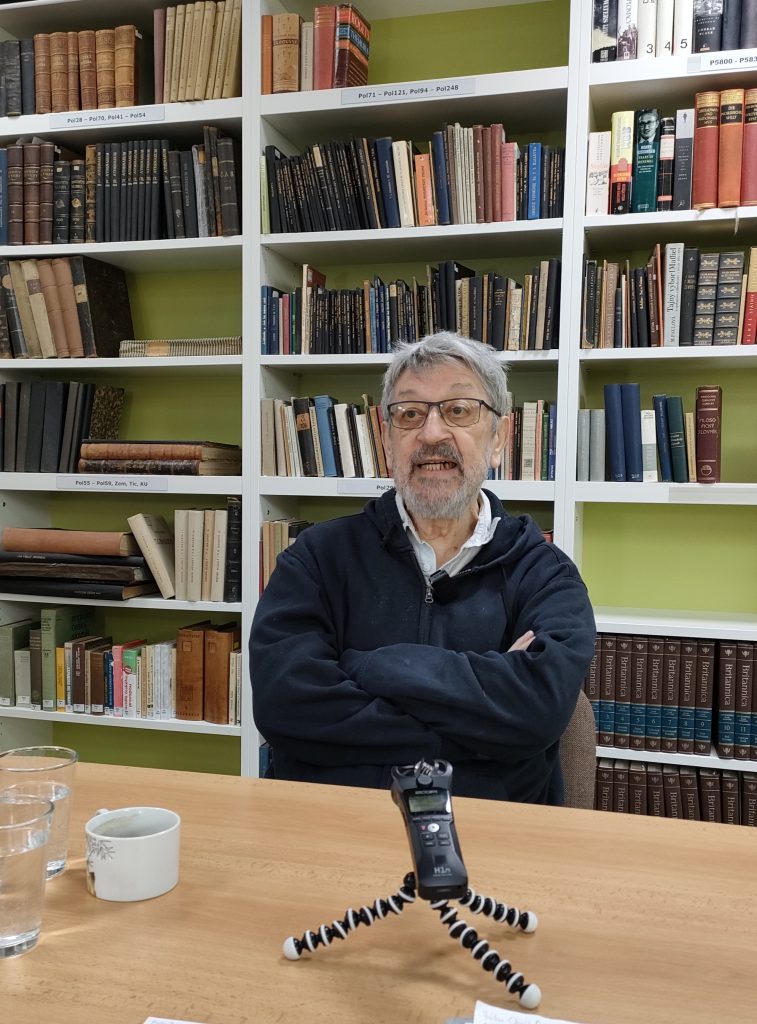
Václav Chvátal, a Czech mathematician born on 20 July 1946, is a professor emeritus at Concordia University in Montreal and a visiting professor at the Faculty of Mathematics and Physics at Charles University in Prague, where he studied in the 1960s.
During the interview, he reminisced about Prague’s cultural life in the 1960s and how his passion for reading led him to graph theory. He reflected on the teaching and mentoring style of Associate Professor Zdeněk Hedrlín and the first academic contacts he made thanks to him in 1965 at a conference in Smolenice, Slovakia. There, the talented „horse from Hedrlín’s stable” was introduced to the brilliant Hungarian mathematician Pál Erdős, an internationally recognised figure in graph theory and other disciplines.
After emigrating from Czechoslovakia to Austria in August 1968, Chvátal obtained a Canadian scholarship at the University of Waterloo thanks to a personal postcard from Erdős. He completed his doctoral studies there in 1970. He made significant advances in the research and application of graph theory, gradually lecturing at McGill University, Stanford University, the Université de Montréal, Rutgers University and finally Concordia University.

The academic progression through various Canadian universities coincidentally demonstrates one of Chvátal’s research topics: Hamiltonian graphs. Such a graph can only be achieved by visiting each node exactly once (i.e. the connectivity and the maximum independent set size). Chvátal and Erdős worked out this result during a long road trip, and at the end of their 1972 article, they thanked their driver, Louise Guy, for her steady driving.
The academic progression through various Canadian universities coincidentally demonstrates one of Chvátal’s research topics: Hamiltonian graphs. Such a graph can only be achieved by visiting each node exactly once (i.e. the connectivity and the maximum independent set size). Chvátal and Erdős worked out this result during a long road trip, and at the end of their 1972 article, they thanked their driver, Louise Guy, for her steady driving.
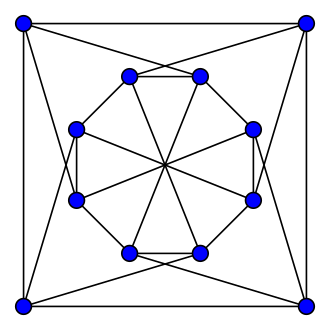
Another example is the so-called Chvátal graph (see figure), which is the smallest possible triangle-free graph that is both 4-chromatic and 4-regular. Chvátal also worked on the travelling salesman problem and first became interested in linear programming. During my interview with him, he reminisced about the complexity and stimulation of establishing graph theory alongside other mathematical disciplines, including topology.
He is the author of the significant monograph The Discrete Mathematical Charms of Paul Erdős (Cambridge University Press, 2021), which describes the emergence of graph theory and other disciplines within discrete mathematics, as well as the circulation of this knowledge between East and West.